
The short answer
Most houses in Wales can have a new or replacement driveway at the front without a planning application. This is allowed under “permitted development”, on one main condition: the surface has to deal with rainwater on your own property.
The Welsh Government’s guidance says a new or replacement hard surface at the front of a house must either be made from permeable or porous materials, or drain into a permeable area, such as a lawn, border or soakaway, within the front garden.
What counts as a permeable driveway?
A permeable surface lets water soak through into the ground below instead of running off onto the road. Common options include:
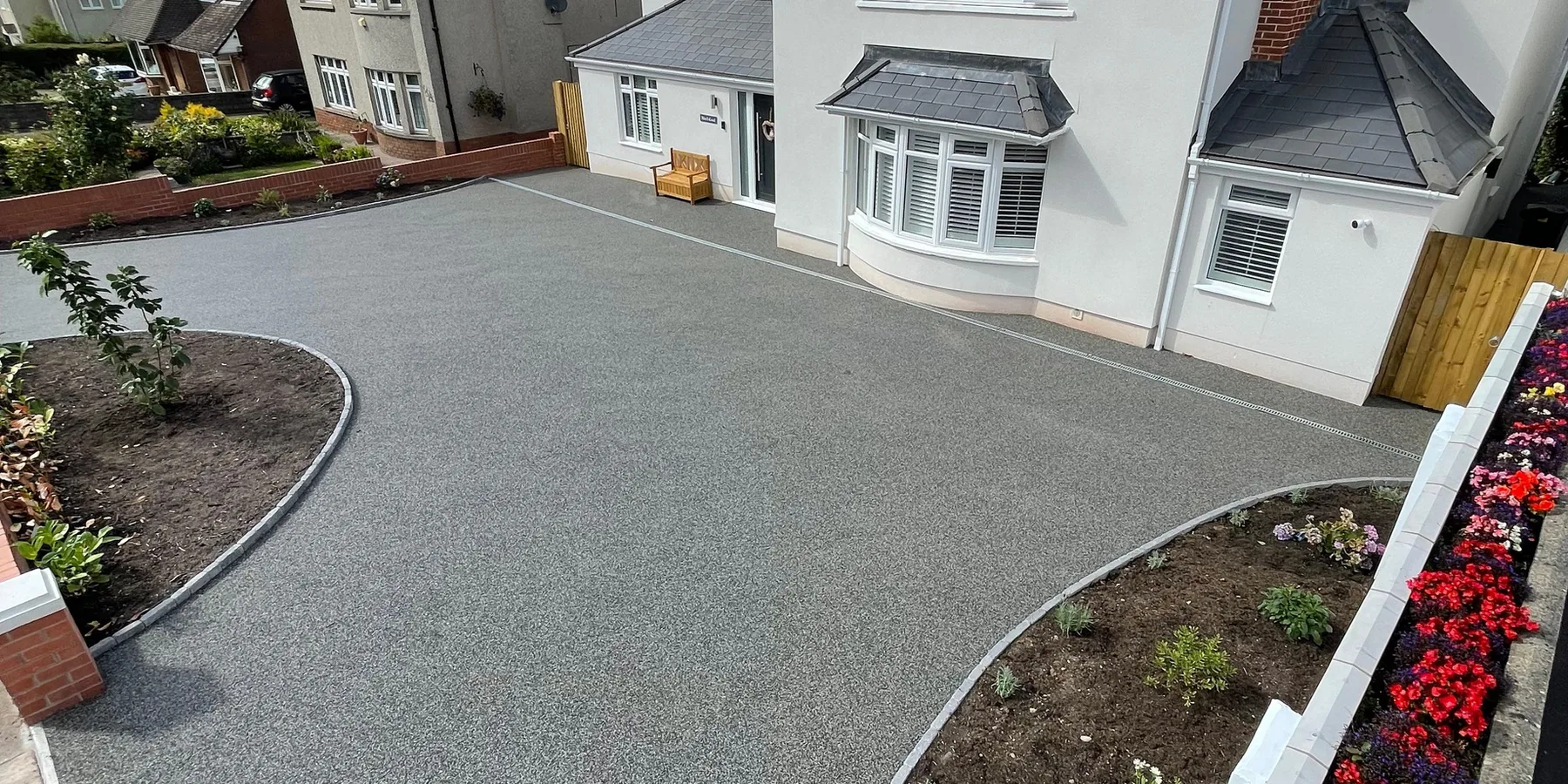
- Resin-bound surfacing, laid on a suitable porous base
- Permeable block paving, which has wider joints and a free-draining sub-base
- Gravel, with a stabilising grid if needed
- Porous tarmac or asphalt
Standard block paving, tarmac and concrete can still be used. The water just has to be directed somewhere it can soak away, for example with channel drains feeding a soakaway or falls towards a planted border. Getting this right is part of designing the driveway, not an afterthought.
The 5 m² rule
You can repair or replace a small area, up to 5 square metres, of existing hard surfacing without using permeable materials. Filling potholes or relaying a few slabs is fine. Anything bigger has to meet the drainage condition above.
When you will need planning permission
- The surface isn’t permeable and doesn’t drain to a permeable area within the front garden
- You live in a flat or maisonette. Permitted development for driveways only applies to houses.
- The property is a listed building
- Permitted development rights have been removed, either by a condition on the original planning permission or by an “Article 4 direction”, which is most common in conservation areas
- The work involves significant embanking or terracing to support the surface
- The new dropped kerb is on a classified road (see below)
If you’re not sure whether any of these apply, Cardiff Council’s planning team can tell you. The planning register shows any conditions on your property.
Dropped kerbs in Cardiff
If you’ll be driving across the pavement to reach the driveway, you need an authorised vehicle crossover, usually called a dropped kerb. This is a separate application to Cardiff Council under the Highways Act 1980.
- In Cardiff, only the council or its nominated contractor can build the dropped kerb itself
- Planning permission is needed first if your road is a classified route
- Tenants need written permission from their landlord
- Applications can be refused, for example if a street tree’s roots would be affected
It’s worth applying early, as the crossover often takes longer than the driveway. We can plan the driveway so it ties in with where the dropped kerb will go.
Bigger projects: SuDS approval
Wales has an extra rule that England doesn’t. If the total area of construction work is 100 square metres or more, the drainage needs approval from the council’s SuDS Approving Body (SAB) before work starts. This includes driveways, patios and extensions added together. Most single driveways come in well under this, but large driveways combined with other work can reach it.
How we handle it
At the home visit we’ll look at the size of the area, the falls, where water currently goes and the surface you’re interested in. We’ll recommend a drainage approach that keeps the driveway within the rules and tell you straight away if anything needs an application.
This guide is a summary for homeowners, not legal advice. Rules can change, so check with Cardiff Council or your local planning authority if your situation is unusual.